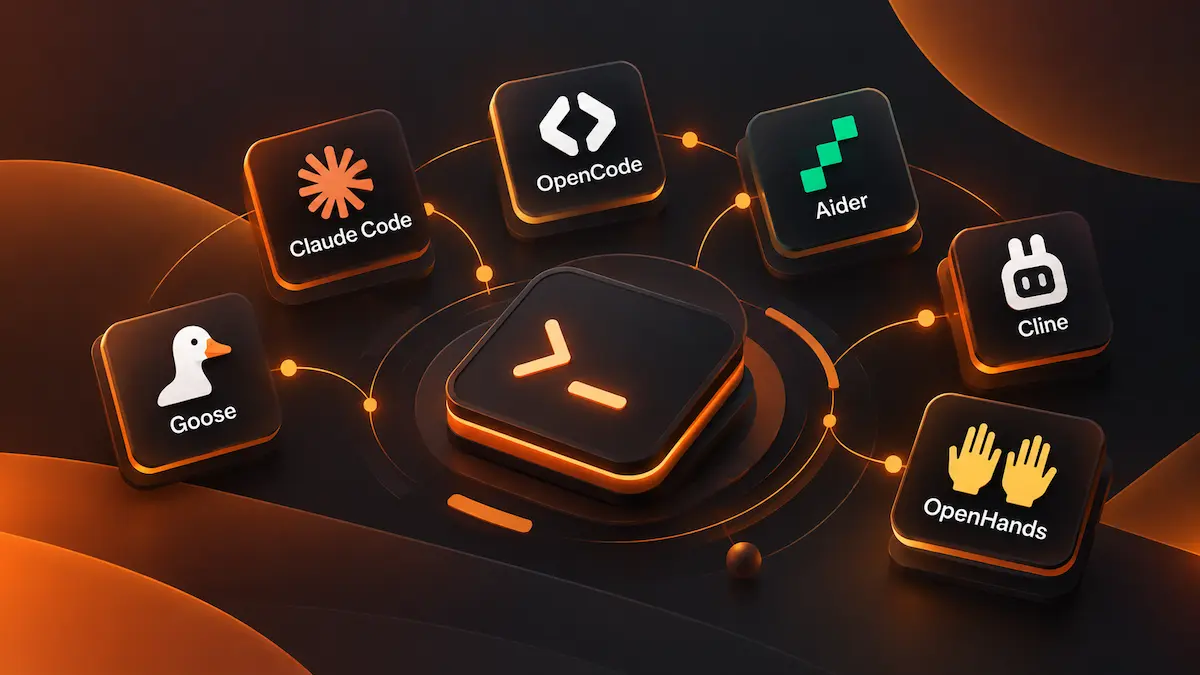
Best Open Source Claude Code Alternatives in 2026: Terminal Agents Compared
Discover the best open source Claude Code alternatives in 2026. Compare OpenCode, Aider, Goose, and Cline for terminal workflows, local LLMs, and MCP support.
Best Open Source Claude Code Alternatives in 2026: Terminal Agents Compared
Anthropic’s release of Claude Code redefined what developers expect from command-line AI. Rather than generating isolated code snippets in a browser window, Claude Code acts as a proactive terminal agent: it inspects local Git trees, runs test suites, captures compiler errors, and writes multi-file refactors directly inside your shell.
However, Claude Code has significant structural constraints. It is closed-source and proprietary software, strictly vendor-locked to Anthropic models, and requires an active subscription ($20–$100+/month) or direct API billing that consumes tokens rapidly during autonomous reasoning loops. For engineering teams requiring code privacy, custom model integration, or air-gapped environments, a proprietary tool is often a non-starter.
The open-source community in 2026 has developed a mature ecosystem of open source Claude Code alternatives. These tools reproduce or expand upon Claude Code’s agentic loop while providing complete transparency, permissive licenses (Apache 2.0 and MIT), and the freedom to connect to local open-weights models or any commercial LLM provider.
This guide provides a comprehensive, verified comparison of the leading open source AI coding agents, detailing their licenses, architecture, terminal execution, and exactly which parts of the Claude Code workflow each tool can replace.

1. What Makes Claude Code Unique? (The Workflow to Replace)
To identify an effective open-source alternative, we must first break down the core capabilities of Claude Code:
- Terminal-Native Presence ──► Operates in active dir
- Codebase Understanding ──► Navigates file trees
- Automated File Editing ──► Multi-file diffs
- Shell Command Execution ──► Runs tests & linters
- Automated Git Operations ──► Creates commits
- Model Context Protocol ──► Extensible via MCP
Claude Code combines an interactive CLI with an autonomous loop: when tasked with fixing a bug, it searches relevant files, proposes modifications, executes your project’s test command, reads the error output, and self-corrects until the suite passes.
Claude Code Limitations
- Proprietary License: The client software cannot be audited, self-hosted, or independently modified.
- Vendor Lock-In: You cannot use local open-weights models (like Qwen 2.5 Coder or DeepSeek Coder) or competing commercial models (like GPT-4o).
- Cost Accumulation: Running iterative multi-file agent loops with frontier models (Claude 3.5 Sonnet or Opus 5.5) consumes thousands of tokens per task.
2. Quick Answer: Which Tool Replaces Which Part of Claude Code?
No single tool is a universal answer for every developer. Here is how the top open-source alternatives map to Claude Code’s features:
- The 1:1 Direct Replacement for Terminal Agility: OpenCode (MIT) — Replaces Claude Code’s terminal TUI, shell execution, multi-agent planning, and Model Context Protocol (MCP) integrations with complete model agnosticism.
- The Best Replacement for Git Workflows & Pair Programming: Aider (Apache 2.0) — Replaces Claude Code’s code editing with token-efficient AST repository mapping and automated, semantic Git commits.
- The Best Replacement for DevOps & System Automation: Goose (Apache 2.0 / Linux Foundation) — Replaces Claude Code’s command execution with an extensible MCP bus supporting 70+ system and API extensions.
- The Best Replacement for Graphical VS Code Workflows: Cline (Apache 2.0) — Replaces Claude Code’s command-line interface with an in-editor autonomous “Plan and Act” agent featuring human-in-the-loop approvals.
- The Best Replacement for Sandboxed Full-Stack Repairs: OpenHands (MIT) — Replaces local shell execution with an isolated Docker container capable of resolving GitHub issues end-to-end.
3. Comparison Table: Claude Code vs. Open Source Alternatives
The following table compares the verified technical capabilities, licenses, and architecture of each tool:
| Tool | License | Primary Interface | Model Flexibility | Local Model (Ollama) Support | Terminal Execution | Codebase AST Map | MCP Support | Active Status (2026) |
|---|---|---|---|---|---|---|---|---|
| Claude Code | Proprietary | Terminal CLI | Locked to Anthropic | No | Full (Bash) | Native | Yes | Active (Commercial) |
| OpenCode | MIT | Terminal TUI & CLI | 75+ Providers (Model-agnostic) | Yes (Native Ollama) | Full (Interactive) | Yes | Yes (Native config) | Active (Rapid releases) |
| Aider | Apache-2.0 | Terminal CLI | Any API + Local | Yes (Native Ollama/vLLM) | Git/Bash integration | Yes (Tree-sitter) | No (Script-based) | Active (Benchmark leader) |
| Goose | Apache-2.0 | Terminal CLI & Desktop | 15+ Providers | Yes (Native Ollama) | Full (Shell/Automated) | Contextual | Yes (70+ extensions) | Active (Linux Foundation) |
| Cline | Apache-2.0 | VS Code Extension | Any API + Local | Yes (Native Ollama) | Full (Supervised terminal) | Yes | Yes (Native MCP) | Active (Top agent) |
| Continue.dev | Apache-2.0 | VS Code / JetBrains | Any API + Local | Yes (Local-first) | Terminal context reading | Yes | Yes | Stable (v2.0 Maintenance) |
| OpenHands | MIT | Docker / Web / CLI | LiteLLM (Universal) | Yes (via LiteLLM proxy) | Full (Docker sandbox) | Yes | Experimental | Active (All Hands AI) |
4. In-Depth Analysis of the Top Open Source Alternatives
1. OpenCode: The Full-Featured Terminal Replacement
Maintained by Anomaly, OpenCode is the most direct open-source alternative to Claude Code in 2026. Distributed under the permissive MIT License, OpenCode provides an interactive Terminal User Interface (TUI) that runs directly inside your shell.
flowchart TD
  A["OpenCode TUI / CLI"]
  B["Build Agent"]
  C["Plan Agent"]
  D["MCP Layer"]
  E["Model Engine: Ollama / Anthropic / OpenAI / DeepSeek"]

  A --> B & C & D
  B -- "Multi-file code & tests" --> E
  C -- "Read-only architecture" --> E
  D -- "Connects DBs, APIs, Tools" --> E
What Part of Claude Code It Substitutes
OpenCode completely substitutes Claude Code’s core workflow:
- Terminal Native: Runs directly in your workspace terminal, rendering interactive diffs and file trees.
- Shell Execution: Runs builds, linters, and test suites, capturing standard output and error logs to self-heal broken implementations.
- Multi-Agent Coordination: Provides dedicated
build(read/write/execute) andplan(read-only analysis) modes to prevent accidental file corruption while exploring unfamiliar codebases. - Model Context Protocol (MCP): Connects to external databases and web tools via
opencode.json. Learn how to set this up in our complete guide on How to Use MCP in OpenCode.
Models & Installation
- Installation: Installed via official script (
curl -fsSL https://opencode.ai/install | bash) or npm (npm install -g opencode-ai). - Supported Models: Compatible with over 75 model providers. You can use Anthropic’s Claude 3.5 Sonnet via an API key, switch to DeepSeek for low-cost tasks, or point it to a local Ollama instance for 100% offline, zero-dollar coding.
2. Aider: The Precision Git-Native Pair Programmer
Created by Paul Gauthier and distributed under the Apache-2.0 License, Aider is the gold standard for terminal-based pair programming with automated version control.
# Starting Aider with a local Ollama model at $0 cost
export OLLAMA_API_BASE=http://localhost:11434
aider --model ollama_chat/qwen2.5-coder:14b
What Part of Claude Code It Substitutes
Aider excels as a substitute for Claude Code’s code editing and version control workflows:
- Automatic Git Commits: Every feature implementation or bug fix is committed automatically with a detailed, semantic commit message. Unwanted modifications can be undone instantly with
git revertor the/undocommand. - Tree-Sitter Repository Mapping: Aider maps class hierarchies, function signatures, and cross-file references across your entire project. This enables the model to understand codebase context with remarkable token efficiency.
- Optimized Diff Engine: Uses specialized unified diff prompts, minimizing hallucinations and avoiding full-file rewrites that inflate token costs.
Considerations
Aider operates strictly through command-line prompts and Git diffs without an interactive graphical TUI. For an overview of zero-cost options, check out our roundup of the Best Free AI Coding Tools.
3. Goose: The Extensible DevOps and Automation Agent
Contributed by Block to the Linux Foundation’s Agentic AI Foundation (AAIF) in late 2025, Goose is an open-source autonomous agent developed under the Apache-2.0 License.
- [ User Command ] ──► goose session / goose run
- [ MCP Bus ] ──► 70+ Native System Extensions
- [ Local Shell ] ──► Runs Python, Shell, Diagnostics
- [ LLM Layer ] ──► Ollama / Claude / OpenAI
What Part of Claude Code It Substitutes
While Claude Code is tailored primarily for software development, Goose substitutes and expands upon its system-level command capabilities:
- DevOps & Infrastructure Automation: Goose excels at managing Docker containers, configuring network routes, provisioning local dependencies, and running multi-step bash scripts.
- Native MCP Architecture: Built on the Model Context Protocol from its inception, Goose connects out-of-the-box to over 70 extensions (GitHub, SQLite, Jira, Google Drive, and cloud APIs).
- Non-Interactive CLI Mode: Run single-command tasks from automated shell scripts via
goose run -t "lint codebase and run pytest".
4. Cline: The Autonomous Agent for VS Code
If you admire Claude Code’s autonomous reasoning loops—executing commands, reading compiler errors, and refactoring multiple files—but prefer working within a graphical editor, Cline is the premier open-source replacement.
- Read Project Files ──► Inspects workspace tree
- Propose Unified Diff ──► Visual approval in editor
- Execute Terminal ──► Runs build and tests
- Self-Healing Loop ──► Reads diagnostics & fixes
What Part of Claude Code It Substitutes
- Supervised Execution (Human-in-the-Loop): Cline explicitly requests user confirmation before executing terminal scripts, creating files, or making destructive edits. To understand how to protect autonomous agents against malicious manipulation, read our report on Agent Tool Hardening.
- In-Editor Terminal Control: Operates directly inside the VS Code integrated terminal, running builds and capturing errors just like Claude Code does in the standalone console.
- Model Agnosticism: Connects to commercial APIs or local Ollama endpoints (
http://localhost:11434) at zero license cost. For a deeper analysis of editor plugins, explore our guide to the Best AI Coding Tools for VS Code.
5. OpenHands: The Sandboxed Autonomous Software Engineer
Formerly known as OpenDevin, OpenHands is a comprehensive autonomous development agent distributed under the MIT License.
What Part of Claude Code It Substitutes
OpenHands substitutes Claude Code’s autonomous problem-solving capabilities within a sandboxed Docker environment:
- Isolated Execution: Because OpenHands runs inside an isolated container, it can run untrusted bash scripts, install experimental packages, and execute complex workflows without risking your host operating system.
- End-to-End Problem Solving: Give OpenHands a GitHub issue description, and the agent will clone the repository, locate the bug, implement the fix, run the test suite, and generate a pull request automatically.
5. Important 2026 Ecosystem Updates: What Happened to Roo Code?
Developers researching open-source coding agents frequently find references to Roo Code. Here is the verified status of the project:
Status of Roo Code in 2026: Roo Code (a popular fork of Cline featuring specialized role-based modes like Architect and Coder) was archived and shut down on May 15, 2026. Its contributors and user community have largely consolidated back into the upstream Cline project. Developers looking for an active, supported agent should install Cline directly from the VS Code Marketplace.
6. Open Source vs. Claude Code: Architectural Trade-Offs
| Dimension | Open Source Alternatives (OpenCode, Aider, Goose) | Proprietary Claude Code (Anthropic) |
|---|---|---|
| Model Independence | Complete: Switch between Claude, GPT, DeepSeek, or local Qwen at will. | Locked: Restricted exclusively to Anthropic Claude models. |
| Data Privacy | 100% Local: Code never leaves your hardware when paired with Ollama. | Cloud-Bound: Source code and terminal outputs are processed in Anthropic cloud. |
| Licensing | Open Source: Permissive Apache 2.0 or MIT licenses; fully auditable code. | Proprietary: Closed-source client software subject to commercial terms. |
| Cost Predictability | Flexible: $0 with local models, or exact per-token API rates with no markups. | Fixed/Usage Markup: Requires $20–$100+/mo subscription or paid API tokens. |
| Tool Extensibility | Native Model Context Protocol (MCP) support across all leading tools. | Native MCP support integrated into the Anthropic tool ecosystem. |
For broader analysis of the open-source landscape, read our comprehensive review of the Best Open Source AI Coding Tools.
7. Recommended Open Source Stacks by Use Case
To get the most out of open-source terminal agents, select the stack that aligns with your specific workflow:
- For Pure Terminal Development (The Direct Claude Code Swap):
- Primary Tool: OpenCode.
- Backend: Anthropic Claude 3.5 Sonnet (for complex architectural tasks) or Ollama with Qwen 2.5 Coder 14B (for private, zero-dollar daily coding).
- Key Advantage: Full interactive TUI with built/plan dual-agent modes.
- For Git-Centric Pair Programming:
- Primary Tool: Aider.
- Backend: DeepSeek Coder via API or local Ollama.
- Key Advantage: Automatic Git commits with clean semantic diffs.
- For DevOps & System Automation:
- Primary Tool: Goose.
- Backend: Local Ollama or OpenRouter.
- Key Advantage: Extensible MCP architecture tailored for shell scripts and cloud APIs.
- For Visual VS Code Users:
- Primary Tool: Cline.
- Backend: Hybrid routing (local Ollama for small edits, Claude for refactoring).
- Key Advantage: Autonomous agent power with visual approval overlays.
8. Frequently Asked Questions (FAQ)
Is there a completely free open source alternative to Claude Code?
Yes. Tools like OpenCode, Aider, and Goose are 100% free and open-source software (MIT and Apache 2.0). To make the AI inference completely free, you simply pair them with Ollama running an open-weights model like Qwen 2.5 Coder 14B locally on your machine. This eliminates all subscription fees and API token costs.
Can open source alternatives use Anthropic Claude models?
Yes. OpenCode, Aider, Goose, and Cline all operate on a “Bring Your Own Key” (BYOK) model. You can enter your Anthropic API key and access the exact same models (such as Claude 3.5 Sonnet or Opus 5.5) that power Claude Code, paying only for the exact tokens consumed without paying for a Claude Pro subscription.
Do open source alternatives support the Model Context Protocol (MCP)?
Yes. Both OpenCode and Goose feature native, first-class support for MCP servers. You can define local and remote servers in configuration files to connect SQLite databases, GitHub tools, and web scrapers directly into your terminal agent sessions.
Can open source terminal agents run offline without an internet connection?
Yes. When configured to communicate with local model runtimes like Ollama, vLLM, or llama.cpp on localhost, tools like OpenCode and Aider can edit files, run bash tests, and generate code completely offline with zero internet access.
What is the difference between OpenCode and Aider?
OpenCode provides an interactive Terminal User Interface (TUI) with dual-agent modes (build and plan) and native MCP configuration. Aider focuses strictly on command-line Git integration, using tree-sitter AST maps to generate token-efficient unified diffs and automatic descriptive Git commits.
Conclusion
Claude Code proved the immense value of terminal-based AI pair programming, but modern software development demands open standards, data privacy, and model flexibility. By choosing OpenCode for multi-model terminal agility, Aider for Git-native refactoring, or Goose for system automation, developers can build a sovereign, production-grade AI coding suite without proprietary constraints.

Yan ZC
Software Developer & Tech Reviewer
Software developer and tech reviewer at ToolReview. I test, analyze, and document AI tools and software workflows. My mission is to help you find the perfect tech stack with honest reviews and rigorous benchmarks.