Free Claude Code Alternatives in 2026: Top Open Source Terminal Agents Tested
Looking for free Claude Code alternatives? Compare OpenCode, Aider, Goose, and Cline. Discover genuine zero-dollar options, local LLM setups, and MCP support.
Free Claude Code Alternatives in 2026: Top Open Source Terminal Agents Tested
Anthropic’s release of Claude Code signaled a major milestone in developer tooling: the transition from passive autocomplete plugins to proactive, terminal-native autonomous coding agents. By executing bash commands, navigating directory trees, reading test outputs, and committing multi-file refactors directly from the command line, Claude Code demonstrated what an agentic pair-programmer could achieve.
However, Claude Code carries two major barriers for many developers: it is neither free nor open-source. Using Claude Code requires an active Claude Pro/Team subscription ($20–$100+/month) or a direct Anthropic Console API key, where context-heavy autonomous loops burn through paid tokens at standard Claude 3.5/Opus rates. Furthermore, Claude Code is strictly locked to Anthropic models, preventing developers from using local hardware or third-party providers.
Fortunately, the open-source community in 2026 offers exceptional free Claude Code alternatives that match or exceed its terminal capabilities while giving you complete ownership of your tools, models, and data.
This guide explores the best free AI coding agents and open source Claude Code alternatives, detailing their architecture, terminal access, codebase comprehension, and how to achieve a genuinely zero-dollar workflow using local open-weights models.
The Critical Distinction: “Free Software” vs. “Free AI Usage”
Before evaluating alternatives, developers must understand a fundamental distinction that marketing materials often obscure:
- Layer 1: The Client Application (Free Software)
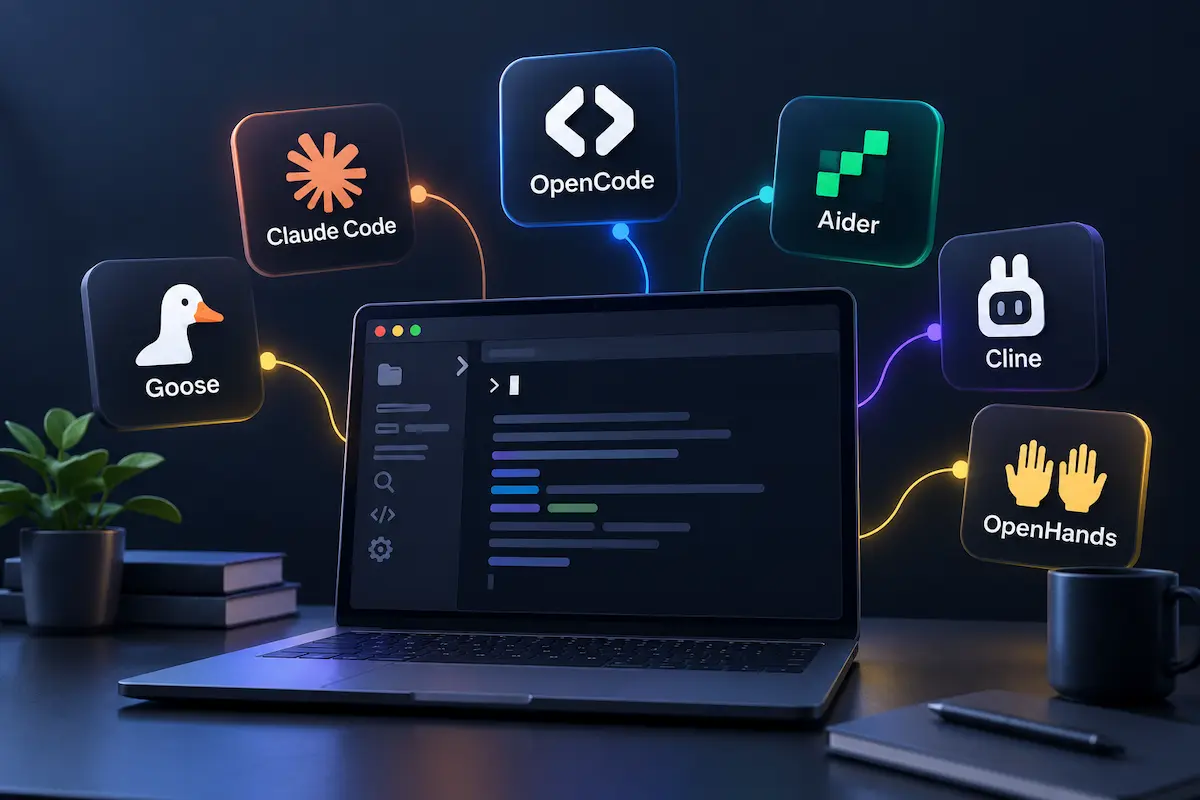
- OpenCode, Aider, Goose, Cline
- 100% Free & Open Source (Apache 2.0 / MIT)
- Layer 2: The Model Inference (The Compute Cost)
- Path A: 100% Free & Private
- Local models via Ollama (Qwen 2.5, DeepSeek)
- Path B: Pay-As-You-Go (BYOK)
- Bring-Your-Own-Key (Anthropic, OpenAI, etc.)
- Path A: 100% Free & Private
- Free Software: The CLI binary, terminal interface, and agent orchestration loop are open source and cost $0 to download, run, and modify.
- Free AI Usage: Generating code requires computing neural network tokens. To achieve a 100% free coding assistant, you must pair the open-source CLI with:
- Local Open-Weights Models: Running models like
Qwen 2.5 CoderorDeepSeek Coderlocally on your GPU/CPU via runtimes like Ollama, vLLM, or llama.cpp. - Free-Tier Cloud Quotas: Connecting to free API allowances (such as Google AI Studio’s free tier credits or OpenRouter’s free model pool).
- Commercial BYOK: Connecting your open-source tool to commercial APIs (Anthropic or OpenAI). Here, the software is free, but you pay raw token rates without paying a monthly editor subscription markup.
- Local Open-Weights Models: Running models like
Quick Answer: The Best Free Claude Code Alternatives at a Glance
- The Best Direct Claude Code Alternative: OpenCode (MIT) — A model-agnostic terminal TUI and CLI agent supporting 75+ model providers, native Model Context Protocol (MCP) integrations, and dual-agent planning.
- The Best for Git-Native Autonomous Coding: Aider (Apache 2.0) — The industry-standard CLI pair programmer that maps your entire codebase using ASTs and authors clean, descriptive Git commits automatically.
- The Best for DevOps & System Workflows: Goose (Apache 2.0 / Linux Foundation) — An extensible local-first agent built natively on MCP with 70+ tool integrations, capable of executing complex shell scripts and environment setups.
- The Best Editor-Based Autonomous Alternative: Cline (Apache 2.0) — An open-source VS Code extension providing the exact same “Plan and Act” multi-file agent loop as Claude Code directly within your graphical editor.
- The Best Sandboxed Autonomous Engineer: OpenHands (MIT) — A containerized agent that executes full-stack repository repairs inside an isolated Docker sandbox.
Comparison Table: Claude Code vs. Free & Open Source Alternatives
| Tool | License | Primary Interface | Model Flexibility | Local Model (Ollama) Support | Terminal Execution | Codebase AST Map | MCP Support | 100% Free Path Available? |
|---|---|---|---|---|---|---|---|---|
| Claude Code | Proprietary | Terminal CLI | Locked to Anthropic | No | Full (Bash) | Native | Yes | No (Paid sub or API required) |
| OpenCode | MIT | Terminal TUI & CLI | 75+ Providers (Model-agnostic) | Yes (Native Ollama) | Full (Interactive) | Yes | Yes (Native config) | Yes (via Local LLM or Free APIs) |
| Aider | Apache-2.0 | Terminal CLI | Any API + Local | Yes (Native Ollama/vLLM) | Git/Bash integration | Yes (Tree-sitter) | No (Script-based) | Yes (via Local LLM or Free APIs) |
| Goose | Apache-2.0 | Terminal CLI & Desktop | 15+ Providers | Yes (Native Ollama) | Full (Shell/Automated) | Contextual | Yes (70+ extensions) | Yes (via Local LLM or Free APIs) |
| Cline | Apache-2.0 | VS Code Extension | Any API + Local | Yes (Native Ollama) | Full (Supervised terminal) | Yes | Yes (Native MCP) | Yes (via Local LLM or Free APIs) |
| OpenHands | MIT | Docker / Web UI / CLI | LiteLLM (Any API) | Yes (via LiteLLM proxy) | Full (Docker sandbox) | Yes | Planned / Experimental | Yes (via Local LLM or Free APIs) |
In-Depth Analysis of the Top Free Claude Code Alternatives
1. OpenCode: The Closest Open-Source Equivalent to Claude Code
Maintained by Anomaly, OpenCode is currently the most direct, feature-complete open-source competitor to Claude Code in 2026. Built with a responsive Terminal User Interface (TUI), OpenCode lives directly inside your terminal workspace.
flowchart TD
  A["OpenCode TUI / CLI"]
  B["Build Agent"]
  C["Plan Agent"]
  D["MCP Layer"]
  E["Model Engine: Ollama / OpenRouter / Anthropic / GPT"]

  A --> B & C & D
  B -- "Writes code, runs tests" --> E
  C -- "Read-only architecture" --> E
  D -- "Connects DBs, APIs, Tools" --> E
Why It Rivals Claude Code
- Model Agnosticism: While Claude Code is locked to Anthropic, OpenCode connects to over 75 model providers. You can run high-reasoning tasks with Claude 3.5 Sonnet, switch to DeepSeek for cost savings, or switch to a local Ollama model when coding offline.
- Dual-Agent Modes: Includes built-in
build(full read/write and terminal execution) andplan(read-only architectural analysis) modes, preventing accidental file modifications while exploring codebases. - First-Class MCP Support: Allows you to configure local and remote Model Context Protocol servers in
opencode.jsonto inspect live databases or query documentation. Learn how to configure this in our complete tutorial on How to Use MCP in OpenCode. - Interactive TUI: Features syntax-highlighted diffs, multi-tab navigation, and visual file tree selection directly inside your shell.
How to Achieve a $0 Workflow
Install OpenCode via npm (npm install -g opencode-ai) or the official script (curl -fsSL https://opencode.ai/install | bash). Connect it to a locally running instance of Ollama using qwen2.5-coder:14b or deepseek-coder. Your entire agent workflow runs on your own hardware at zero cost.
2. Aider: The Industry Benchmark for Git-Native Pair Programming
Aider is widely considered the pioneer of terminal-based AI coding. Distributed under the Apache-2.0 license, Aider focuses specifically on seamless version control and code refactoring.
# Running Aider completely free using a local Ollama model
export OLLAMA_API_BASE=http://localhost:11434
aider --model ollama_chat/qwen2.5-coder:14b
Why It Rivals Claude Code
- Automatic Git Commits: Every time Aider implements a function, fixes a bug, or runs a test suite, it generates a clean Git commit with a detailed explanatory message. Reverting unwanted changes requires only a single
git revertor/undo. - Tree-Sitter Repository Mapping: Aider builds a structural map of your entire project, indexing function signatures and class definitions across multiple files without overflowing model context windows.
- Exceptional Token Efficiency: Aider’s prompt engineering formats unified diffs with extreme precision, avoiding the full-file rewrites that inflate token bills in other agents.
Considerations
- Aider does not feature an interactive graphical TUI; it operates purely through command-line inputs and terminal diffs.
- For broader comparisons of open-source tools, review our guide to the Best Open Source AI Coding Tools.
3. Goose: The Extensible DevOps and Automation Agent
Originally created by Block and contributed to the Linux Foundation’s Agentic AI Foundation (AAIF) in late 2025, Goose is a local-first autonomous agent built for developers and site reliability engineers.
- [ Developer Prompt ] ──► goose session / goose run
- [ MCP Extension Bus ] ──► 70+ Built-in Tools
- [ Local Sandbox ] ──► Executes Shell, Tests, Python
- [ Model Layer ] ──► Ollama / Claude / OpenAI
Why It Rivals Claude Code
- Broad System Automation: While Claude Code focuses primarily on software engineering, Goose excels at multi-step operational tasks: provisioning local dev environments, debugging network sockets, managing Kubernetes manifests, and executing bash scripts.
- Extensible MCP Core: Goose was built around the Model Context Protocol from day one, offering access to 70+ pre-built extensions (GitHub, SQLite, Jira, Google Drive, and cloud APIs).
- One-Shot CLI Execution: You can invoke Goose for rapid, non-interactive tasks directly from scripts using
goose run -t "refactor migrations and run pytest".
4. Cline: The Graphical Autonomous Agent for VS Code
If you love the autonomous capabilities of Claude Code (reading terminal logs, modifying multiple files, running builds) but prefer working inside a modern editor rather than a raw terminal window, Cline is the ideal alternative.
- Read Project Files ──► Analyzes workspace tree
- Propose Unified Diff ──► Visual approval in editor
- Execute Terminal ──► Runs build and tests
- Fix Diagnostics ──► Reads errors & self-heals
Why It Rivals Claude Code
- Human-in-the-Loop Safeguards: Cline explicitly prompts you before executing shell commands, creating files, or deleting code, preventing unintended destructive actions.
- Model Context Protocol Native: Connect external tools and databases directly into your editor session. To protect against malicious tool manipulation, review our report on Agent Tool Hardening.
- Local LLM Integration: Point Cline directly to local Ollama endpoints (
http://localhost:11434) to execute autonomous multi-file refactoring without paying cloud API fees. - For an in-depth editor breakdown, explore our guide to the Best AI Coding Tools for VS Code.
How to Set Up a 100% Free Claude Code Alternative Stack
To replicate the Claude Code experience on your local machine with $0 in recurring subscription fees and $0 in API token costs, follow this three-step setup:
- Step 1: Install Ollama Engine (Inference)
ollama serve
- Step 2: Pull Benchmark Coding Model
ollama pull qwen2.5-coder:14b
- Step 3: Launch OpenCode or Aider
opencode(configured to localhost:11434)
Step 1: Install Ollama
Download and run Ollama on your system to manage local model execution.
Step 2: Pull a Benchmark Open-Weights Model
For machines with 16GB–24GB of RAM or VRAM, Qwen 2.5 Coder 14B offers near-commercial performance on code generation and multi-file diffs:
ollama pull qwen2.5-coder:14b(For lightweight systems with 8GB RAM, use qwen2.5-coder:7b).
Step 3: Run OpenCode or Aider Locally
Launch your open-source terminal agent pointed to your local Ollama port:
# Running Aider
aider --model ollama_chat/qwen2.5-coder:14b

# Or running OpenCode
opencode
Your coding agent will now index your project, execute terminal tests, and edit source code completely offline with zero telemetry and zero bills. For more zero-cost options, check out our roundup of the Best Free AI Coding Tools.
Security Considerations: Running Autonomous Terminal Agents
Giving any AI agent terminal access involves inherent operational risks. Autonomous agents can run shell commands, install npm packages, and alter database state.
Essential Security Rules
- Never Run as Root / Administrator: Always execute OpenCode, Aider, or Goose under an unprivileged user account.
- Audit
opencode.jsonin Cloned Repositories: Because OpenCode executes commands defined in configuration files, always inspect project-level files before launching an agent in a newly cloned repo. - Keep Approvals Active: Maintain confirmation gates for destructive actions (e.g.,
rm -rf,DROP TABLE, orgit push --force).
Frequently Asked Questions (FAQ)
Why isn't Claude Code free?
Claude Code relies on frontier reasoning models (such as Claude 3.5 Sonnet and Claude Opus 5.5). Running these large-scale models requires substantial GPU server infrastructure. Because autonomous coding agents repeatedly loop—reading dozens of files, running test suites, and revising diffs—they consume thousands of tokens per task, making an unmetered free tier financially unviable for Anthropic.
Which free alternative is most similar to Claude Code?
OpenCode is the closest equivalent. It operates as a terminal-native CLI and TUI, supports file editing, runs shell commands, handles multi-agent planning, and supports Model Context Protocol (MCP) servers, while remaining completely open-source and model-agnostic.
Can I use an Anthropic API key in open source alternatives instead of paying for a subscription?
Yes. Tools like OpenCode, Aider, Goose, and Cline all support “Bring Your Own Key” (BYOK). You can provide your Anthropic API key and pay only for the exact tokens consumed, completely bypassing the mandatory $20/month Claude Pro subscription.
Can open source alternatives match Claude Code's performance?
When connected to commercial frontier models via API (such as Claude 3.5 Sonnet or GPT-4o), open-source agents like Aider and OpenCode match or even exceed Claude Code due to specialized features like Aider’s tree-sitter repository map. When running local open-weights models (like Qwen 2.5 Coder 14B), performance is impressive for routine refactoring and bug fixes, though frontier cloud models remain superior for complex multi-package architectural migrations.
Can I use free Claude Code alternatives completely offline?
Yes. By pairing open-source tools like OpenCode, Aider, or Goose with a local model runtime like Ollama, all inference and file modifications occur on your local GPU or CPU with zero internet connection required.
Conclusion
While Claude Code established the power of autonomous terminal pair programming, developers are not forced to accept vendor lock-in, closed source code, or recurring subscription fees. By adopting open-source alternatives like OpenCode for multi-model terminal agility, Aider for Git-native refactoring, or Goose for system automation, you can harness the cutting edge of agentic AI coding on your own terms.

Yan ZC
Software Developer & Tech Reviewer
Software developer and tech reviewer at ToolReview. I test, analyze, and document AI tools and software workflows. My mission is to help you find the perfect tech stack with honest reviews and rigorous benchmarks.