Claude Opus 5.5 in Action: The Future of Software Architecture Workflows
Exploring Anthropic's massive September 2026 updates: Claude Opus 5.5 for deep software engineering, Fable 5.1, Mythos 5.1, and the cache-pricing revolution.
Anthropic’s September 2026: Claude Opus 5.5 and Claude Fable 5.1
September 2026 has been a landmark month for AI-assisted development. While other organizations focus on consumer chatbots, Anthropic has firmly planted its flag in the enterprise and developer ecosystem. With the release of Claude Fable 5.1 earlier in the month, and the surprise drop of Claude Opus 5.5 on September 22, the landscape of software engineering workflows has been completely redefined.
1. Claude Opus 5.5: Built for Software Engineering
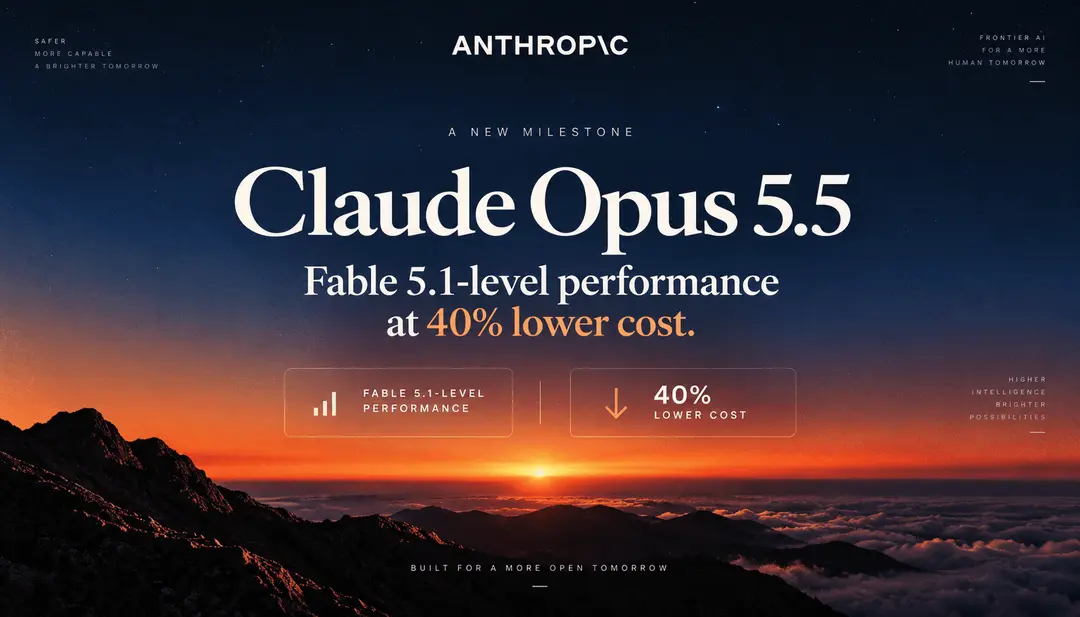
Released on September 22, Claude Opus 5.5 is the first model of the 5.5 series. Unlike previous iterations that aimed for broad, generalized intelligence, Opus 5.5 is aggressively tuned for long-horizon agentic coding and continuous software architecture.
Almost immediately after its launch, Opus 5.5 was integrated into developer environments like GitHub Copilot.
Performance Comparison in Continuous Workflows
In modern development, an AI must do more than write a single function. It must understand the entire monorepo, track dependencies, and architect structural changes without breaking existing logic.
Opus 5.5 excels in continuous development workflows because of its:
- Superior Contextual Memory: When refactoring a microservice, Opus 5.5 actively tracks how changes in one file cascade through API gateways and database schemas.
- Speed and Efficiency: It boasts significantly faster output speeds compared to Opus 5, while being 40% more cost-efficient. This allows autonomous coding agents to iterate faster during test-driven development (TDD) loops.
- Architectural Reasoning: When asked to migrate a legacy system to a modern meta-framework, Opus 5.5 reliably generates cohesive migration plans, rather than disjointed code snippets.
2. The Game Changer: 75% Reduction in Cache-Read Pricing
Perhaps the most impactful announcement for enterprise teams was Anthropic’s massive 75% reduction in cache-read pricing. This isn’t just a billing update; it is a fundamental shift in how applications are built with LLMs.
Breaking Down the Costs
To understand the magnitude of this change, let’s look at the pricing structure for Opus 5.5:
- Standard Input Tokens: $4.00 per 1 million tokens.
- Cached Input Tokens: $0.20 per 1 million tokens.
- Output Tokens: $20.00 per 1 million tokens.
Why This Matters for Developers
Previously, loading an entire codebase (e.g., a 500,000-token repository) into the AI’s context for every single query was financially unviable. Teams had to rely on complex, imperfect RAG (Retrieval-Augmented Generation) systems to fetch only relevant snippets.
Let’s do the math: If an agent evaluates a 500k-token repository 100 times a day, traditional input pricing would cost $200/day ($4 * 0.5M * 100). With the new cache pricing, keeping that repository active in memory drops the cost to just $10/day ($0.20 * 0.5M * 100).
With this pricing cut, developers can afford to keep their entire repository permanently cached in the model’s memory during a coding session. Every prompt you send evaluates against the entire codebase almost instantly, practically eliminating “hallucinations” caused by missing context.
Demonstration of Claude interacting with a massive cached codebase in real-time.
3. Early September Releases: Fable 5.1 and Mythos 5.1
Before Opus 5.5 stole the spotlight, Anthropic released the 5.1 mid-tier heavyweights on September 1:
Claude Fable 5.1
Positioned for highly demanding reasoning tasks outside of pure code generation, Fable 5.1 is the go-to model for long-horizon agentic workflows, complex data analysis, and multi-step research. Priced at $10 per million input tokens, it serves as the intellectual workhorse for enterprises.
Claude Mythos 5.1
Released alongside Fable, Mythos 5.1 is a fascinating development. It is the exact same underlying model as Fable 5.1, but deployed with significantly more permissive guardrails. Because it is less likely to refuse complex or sensitive tasks, Mythos 5.1 is strictly access-controlled. It is only available to vetted organizations participating in specific cybersecurity (e.g., red-teaming, vulnerability analysis) and life-sciences research programs.
4. Frequently Asked Questions (FAQ)
What is the main difference between Claude Fable 5.1 and Claude Opus 5.5?
Fable 5.1 is built for broad, deep reasoning tasks (like data analysis and academic research), whereas Opus 5.5 is aggressively specialized for continuous software architecture and agentic coding workflows. Opus 5.5 is also significantly cheaper for standard inputs ($4/M vs Fable’s $10/M).
How does the 75% cache discount work in practice?
When you send a large prompt (like a codebase), Anthropic’s API caches the input. If you send subsequent requests within the cache’s TTL (Time-To-Live) that share the same initial prefix, you are only billed $0.20 per million tokens for reading that cached context, rather than the full $4.00.
Does Opus 5.5 replace GitHub Copilot's default models?
GitHub Copilot now operates on a multi-model ecosystem using usage-based billing (GitHub AI Credits). While OpenAI models are still available, users can actively select Claude Opus 5.5 within their Copilot interface to handle massive refactoring tasks.
How can my organization access Mythos 5.1?
Mythos 5.1 requires manual vetting. Your organization must contact Anthropic’s enterprise sales team and prove involvement in certified cybersecurity red-teaming or sensitive life-sciences research to gain API access.
Conclusion
Anthropic’s strategy in late 2026 is crystal clear: dominate the professional workflow. By combining the profound software engineering capabilities of Claude Opus 5.5, deep integrations with GitHub Copilot, and an aggressively cheap caching structure, Anthropic has built the ultimate toolkit for modern software architecture. The era of the AI pair-programmer has officially transitioned into the era of the AI Staff Engineer.

Yan ZC
Software Developer & Tech Reviewer
Software developer and tech reviewer at ToolReview. I test, analyze, and document AI tools and software workflows. My mission is to help you find the perfect tech stack with honest reviews and rigorous benchmarks.